Disclaimers
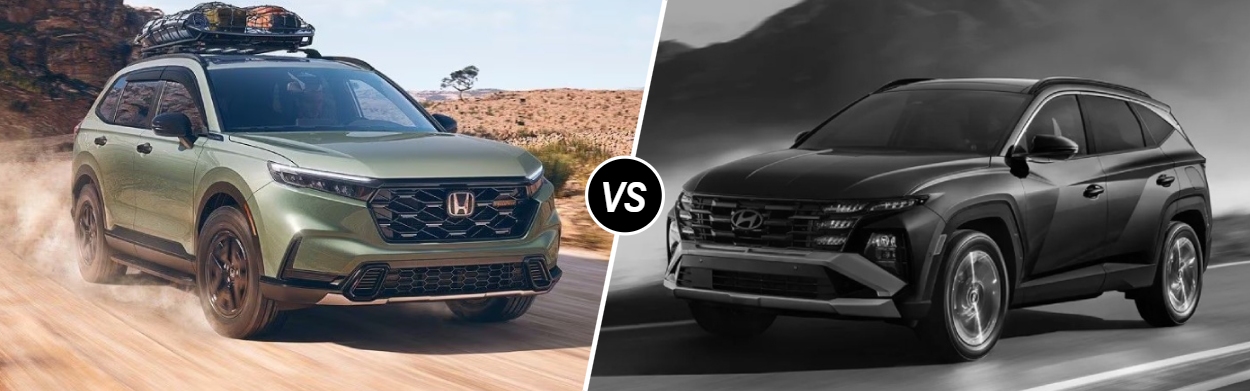
2026 Honda CR-V Hybrid vs 2026 Hyundai TUCSON Hybrid
Shoppers comparing the 2026 Honda CR-V Hybrid vs 2026 Hyundai TUCSON Hybrid will find two well-rounded compact hybrid SUVs with impressive tech and reassuring safety equipment. The critical differences begin with the CR-V Hybrid’s clean, intuitive cabin design, standard 9-inch color touch-screen on every trim, and the availability of Google built-in on Sport Touring Hybrid, making everyday tasks like navigation, voice assistance, and app use feel seamless. Hyundai counters with a standard 12.3-inch display and standard HTRAC AWD, but the CR-V Hybrid’s Real Time AWD™ availability, thoughtful packaging, and refined hybrid tuning shine in daily life. Around town in West Burlington, IA, the Honda’s smooth two-motor hybrid system delivers confident, quiet acceleration with fewer shifts and less fuss, and its cargo area is engineered to be flexible for grocery runs, rec sports gear, or weekend escapes along the river. At Brad Deery Honda, we focus on how a vehicle fits your routine: clear controls you learn once and keep using, safety systems that fade into the background until you need them, and cabin space that actually works. That is where the CR-V Hybrid consistently edges out the Tucson Hybrid.
| Feature | 2026 Honda CR-V Hybrid | 2026 Hyundai TUCSON Hybrid |
|---|---|---|
| Hybrid powertrain available | Yes | Yes |
| All-wheel drive (AWD) availability | Yes | Yes |
| Google built-in | Yes | No |
| Wireless Apple CarPlay and Android Auto | Yes | Yes |
| Hands-free power tailgate/liftgate | Yes | Yes |
| Leather-trimmed seats available | Yes | Yes |
| One-touch power moonroof available | Yes | Yes |
| Wireless phone charger | Yes | Yes |
| Comprehensive driver-assist suite standard | Yes | Yes |
| 9-inch color touch-screen standard | Yes | No |
Exterior - Honda Dealer serving West Burlington, IA
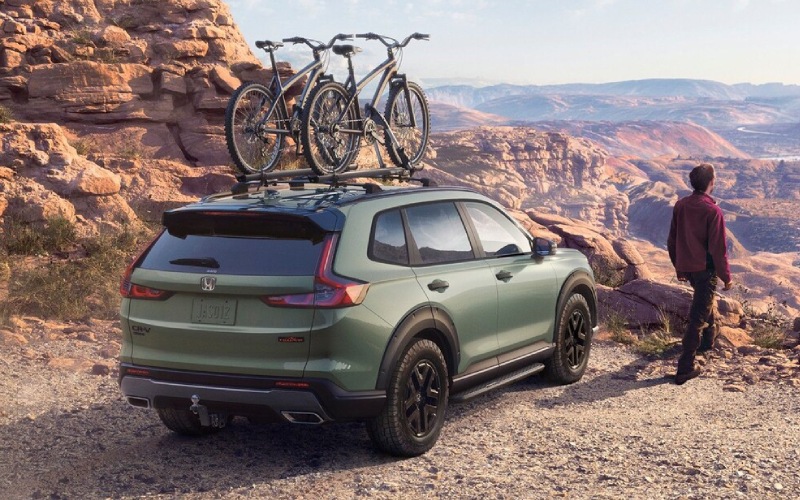
The 2026 CR-V Hybrid wears athletic, confident proportions with a long hood, upright stance, and a grille that looks cohesive across trims, from Sport Hybrid to TrailSport Hybrid. Details like the black wheel arches, available 19-inch wheels, and sculpted LED lighting give it a premium, mature look without shouting. Practical touches include an available Hands-Free Access Power Tailgate on Sport Touring Hybrid and a Power Tailgate with programmable height on EX-L, Sport-L Hybrid, and TrailSport Hybrid, which is particularly helpful in garages and carports around older neighborhoods in West Burlington, IA. Honda’s color palette, including Ash Green Metallic and Radiant Red Metallic, is contemporary yet tasteful, and the integration of roof rails and accessories is clean for those who want bikes or a cargo box along Highway 61. The TUCSON Hybrid goes bold with angular lines and a distinctive lighting signature, which some shoppers love. Yet the CR-V’s purposeful design yields real-world benefits: easy door openings for child seats, a wide tailgate aperture for bulky cargo, and bumper corners you can judge at a glance when parallel parking near the riverfront. Functional elegance remains a CR-V hallmark, and the hybrid trims preserve that identity while adding sport accents and rugged TrailSport cues.
Interior - 2026 Honda CR-V Hybrid in West Burlington, IA
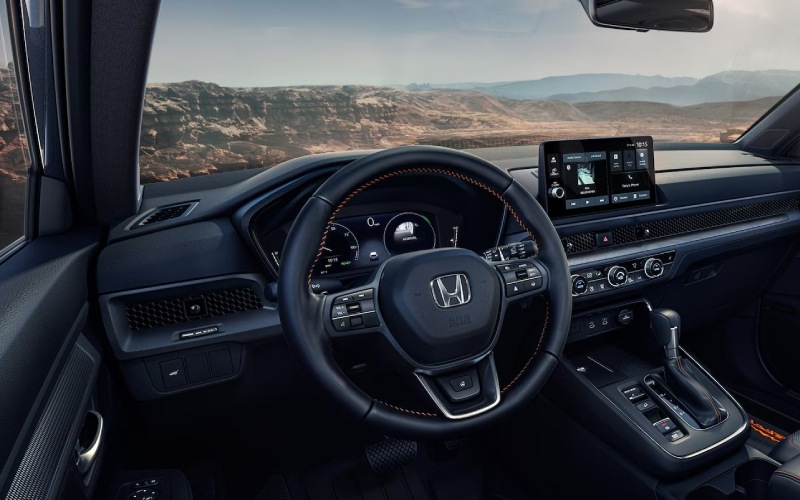
Open the door, and you see why the 2026 Honda CR-V Hybrid remains a go-to for families and commuters. The dash layout is calm, with a clean metal-mesh design across the vents, an easy-to-reach 9-inch color touch-screen standard on all trims, and wireless Apple CarPlay® and Android Auto™ standard. Wireless phone charging is also standard, so cords do not clutter the center console. On EX and above, a one-touch power moonroof brightens the cabin, and trims like Sport-L Hybrid and Sport Touring Hybrid bring leather-trimmed seats and additional soft-touch surfaces. Rear-seat space is generous, and the cargo area is shaped to accept strollers, coolers, and bulky boxes without a wrestling match. The CR-V Hybrid’s flat load floor and low liftover help when you are loading home-improvement supplies after a stop along Roosevelt Avenue in West Burlington, IA. Hyundai’s TUCSON Hybrid offers a striking panoramic display and premium touches on upper trims, but day-to-day usability still favors the Honda: the menus are straightforward, physical knobs remain for climate and audio basics, and the seats strike that Honda-familiar balance of firm support and all-day comfort. For long drives between Burlington and Iowa City, clear sightlines and hushed road noise are bonuses you feel mile after mile.
Honda CR-V Hybrid vs Hyundai TUCSON Hybrid Mechanical Specs
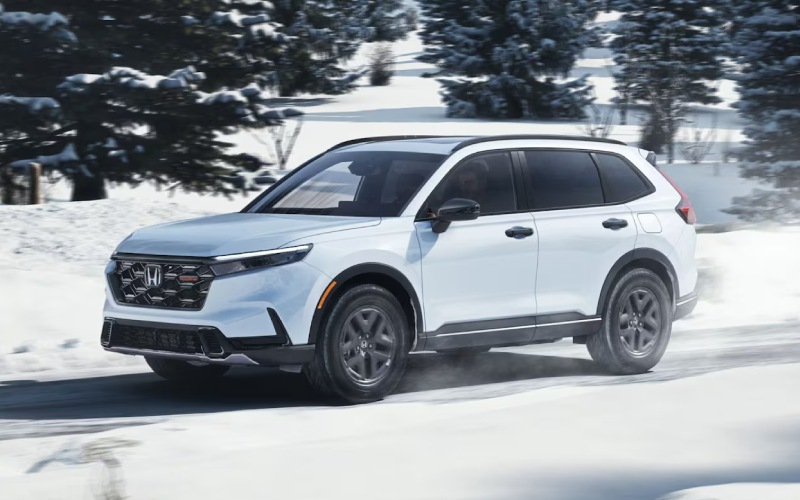
Chassis tuning is where the 2026 CR-V Hybrid quietly makes its case. The suspension is settled and controlled over patched pavement, dampening small impacts you find on county roads outside town while maintaining composure on quicker freeway transitions. Steering weight is natural and build-up feels linear, giving you a sense of connection without nervousness on breezy days crossing the Mississippi. Brake blending in the hybrid system is another strong suit: pedal feel is consistent whether you are recapturing energy or stopping at a light on Agency Street. Real Time AWD™ is available across most trims and standard on TrailSport Hybrid and Sport Touring Hybrid, helping distribute torque intelligently when the surface changes from wet leaves to gravel to clean asphalt. Honda’s multi-mode drive system includes Sport mode on all hybrid trims and tailor-made calibration to keep responses predictable and confidence-inspiring. The TUCSON Hybrid’s e-Handling and standard HTRAC AWD provide noteworthy traction and stability, especially in inclement conditions. Still, over broken streets and during tight parking maneuvers, the CR-V Hybrid’s tuning prioritizes calm, quiet progress and easy control. That blend of mechanical refinement and predictability is exactly what makes the Honda feel ready for everything from short school drop-offs to weekend road trips.
Powertrain - Honda Dealership in West Burlington, IA
The 2026 Honda CR-V Hybrid uses Honda’s latest two-motor hybrid system, pairing a 2.0-liter Atkinson-cycle engine with two electric motors for a combined 204 horsepower. Rather than a traditional stepped automatic, Honda’s system varies drive ratios seamlessly to keep the engine in its sweet spot and deliver smooth, near-silent acceleration in city driving. That composure stands out downtown when you want a quick response merging onto primary routes or a quiet cabin on rolling two-lane roads out of town. The TUCSON Hybrid counters with a 1.6-liter turbocharged engine, electric motor, and a 6-speed automatic, rated at 231 combined horsepower, which brings robust passing performance. Yet on light-throttle starts and low-speed crawling, you feel more shifting activity than you do in the Honda. The CR-V Hybrid’s programming also leans into electric torque for responsive step-off while preserving a natural engine note under load. For drivers who value a vehicle that simply does not call attention to itself, the Honda’s hybrid integration feels mature and cohesive. Factor in the availability of Real Time AWD™ for variable Midwest conditions and the consistent pedal mapping that makes stop-and-go traffic less tiring, and the CR-V Hybrid’s powertrain delivers the kind of refinement owners appreciate year after year.
Safety - Honda CR-V Hybrid vs Hyundai TUCSON Hybrid
Both SUVs come standard with a robust active-safety suite. Every CR-V Hybrid includes Honda Sensing®, which bundles Collision Mitigation Braking System™, Road Departure Mitigation, Lane Keeping Assist System, Adaptive Cruise Control with Low-Speed Follow, and Traffic Sign Recognition. Blind Spot Information System with Cross Traffic Monitor is also widely available, enhancing awareness in busy parking lots off bustling corridors in West Burlington, IA. The system calibration in the Honda is deliberately smooth: steering assistance is subtle, lane-centering is unintrusive, and alerts are easy to parse without being startling. Hyundai SmartSense on the TUCSON Hybrid is equally comprehensive, offering features like Lane Keeping Assist, Blind-Spot Collision Warning, and, on upper trims, Surround View Monitor and Remote Smart Parking Assist. Hyundai’s tech-rich approach is compelling, but what tilts the balance for many shoppers is how naturally the CR-V Hybrid’s assistance fades into the background when not needed and how its clear instrumentation keeps information readable at a glance. It is the difference between technology you constantly manage and technology that simply lends a hand. For daily life around neighborhoods, ramps, and highway stretches, the Honda’s careful tuning helps build trust and reduces fatigue.
Why Drivers in West Burlington, IA Choose the 2026 Honda CR-V Hybrid
- Performance poise: A refined two-motor hybrid delivers smooth, quiet acceleration with predictable response and available Real Time AWD™ for changing surfaces.
- Comfort and technology: Standard 9-inch touch-screen, wireless Apple CarPlay® and Android Auto™, wireless charging, and available Google built-in on Sport Touring Hybrid.
- Everyday utility: Flexible cargo area, wide tailgate opening, and easy-to-use controls that fit errands and weekend plans across the region.
Our recommendation: If you value a calm, intuitive drive that stays composed through every errand and every mile, the CR-V Hybrid is the smarter long-term partner.
Request more 2026 Honda CR-V Hybrid information
Choosing between the 2026 Honda CR-V Hybrid vs 2026 Hyundai TUCSON Hybrid is not about spec-sheet victories—it is about how each SUV supports the rhythm of your day. The TUCSON Hybrid is feature-rich and strong on paper, but the Honda’s real-world tuning, natural controls, and standard 9-inch interface help you settle in quickly and stay focused on the road. Available Google built-in on Sport Touring Hybrid, the thoughtful cargo area, and Real Time AWD™ breadth make the CR-V Hybrid easy to live with on everything from quick cross-town trips to longer drives out of West Burlington, IA. At Brad Deery Honda, we see drivers pick the CR-V Hybrid because it feels right from the first test drive: quiet, composed, and intuitively laid out. If you need a compact hybrid SUV that will support your routine without drama—while offering space, safety, and technology that just works—the Honda should be at the top of your list. Visit our team at Brad Deery Honda to see how the 2026 CR-V Hybrid fits your life today.
126 Results